Blog

Uncategorized

Thoughts on Information Dissemination and Attention Spans in Today’s World

Whether it is Donald Trump being elected as the Republican nominee, Brexit, or any other serious topic in today’s world, there is a common link that I feel exists behind such instances. In this blog post I’ll try to explain what it has got to do with psychology, biases, and more importantly, thinking.

(Critical?)Thinking

Forget about critical thinking, even thinking in today’s world is underrated. It is too easy to make some believe in a notion, given that you have the apparatus for it. People fall for all kinds of bullshit, all the time. How many of us think before making decisions, whether it is choosing a school, a major, a political party or even a referendum to leave the EU or not? In my opinion, very few of us do that. Even when few actually think, it’s not good enough. That in itself is not surprising since the law of averages works everywhere, meaning most people are average at best when it comes to thinking. Combine this with the fact that people only listen to what they like, add a pinch of ignorance, and use this with short attention spans that we have today, and you can probably explain these occurrences which appear baffling to at least a section of society.

Information Dissemination and Thinking

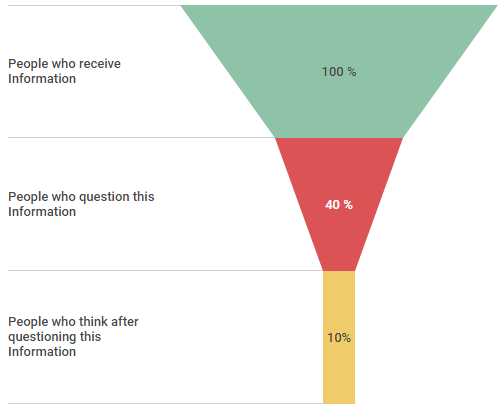
Here’s a rough infographic I made to highlight what I think is a major issue when it comes to thinking in today’s world. Information penetrates at different levels within the population thereby making the judgement process skewed and in most cases driven by superficial evidence which might be misleading to say the least.
Information Penetration

I might be overestimating the number of people who actually think or I might just be wrong (in which case I would be happy to correct myself), but what I feel is clear is that thinking is a dwindling phenomenon. I discuss this further under Attention Spans.

There is just too much information and not enough time or interest among people to think about everything before taking a decision. I feel this can explain why masses are easily swayed by slogans and why politicians, celebrities, etc feel necessary to pander to the public every once in a while.

The Confirmation Bias

The essence of the confirmation bias is that you see what you want to see. Even when presented with evidence contrary to your beliefs or alternative to your thinking you choose to ignore those, sticking to what you think is correct.

Consider the ramifications this has over the events that I’ve mentioned at the start. Donald Trump supporters cannot see why he’s wrong, they can only hear sentences they want to.

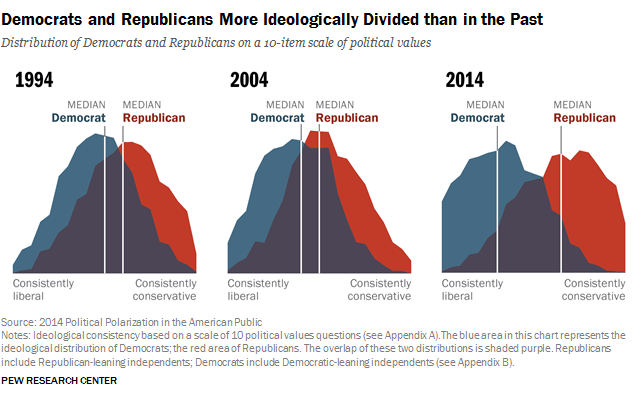
While I’m no expert on the US elections or their mentality, the political polarization is there for everyone to see. Here’s an infographic on Political Polarization from Pew Research Center.
Political Polarization

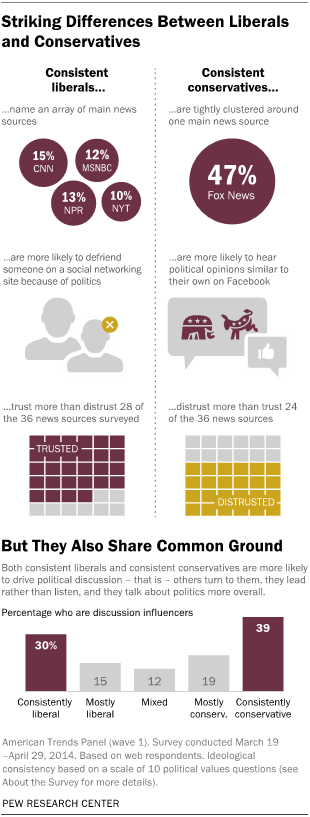
This polarization I believe is in part created by the media. My dissatisfaction with the media in general is probably worth a blog post and something I might work on later. But just to connect the dots between the confirmation bias, not thinking and the effect of media on public sentiment here’s another infographic from Pew Research Center on Political Polarization and Media Habits.
Political Polarization and Media Habits

Some other interesting finds from this study (I’m summarizing them):

  • Consistent conservatives are tightly clustered around one news channel, meaning they receive most of their information from a single source thereby increasing the chance of bias creeping in. Also, they are more distrustful of news outlets in general. They are also more likely than other ideological groups to hear political opinions in line with their own views. They are also more likely to have friends who share the same views. See anything that strikes you ?
  • Consistent liberals rely on a greater number of sources for information and are in general more trusting of news outlets. They are more likely to unfriend or block people on social media because of political reasons, meaning they don’t want to hear the other side of the story?

It is clear that both sides of the political spectrum have biases which have now led to the creation of the biggest ideological gap in decades.

This article is not meant to discuss political ideologies, nor am I commenting on or comparing the two. I just happened to take this up as an example to explain my views on why these things could have happened.

Attention Spans

With the world becoming more and more “social” and the constant and unending flow of information, our attention spans have reduced to those of gnats. There is not enough time to put in the effort to understand and process information, but only enough to consume.

Here are some statistics from National Center for Biotechnology Information, U.S. National Library of Medicine and The Associated Press on Attention Spans and how they’ve reduced over time.
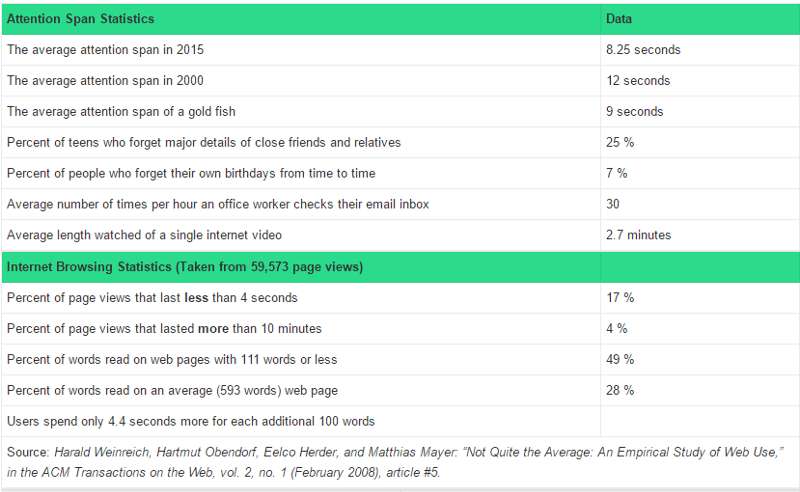
Attention Spans

Here’s a very click-baity article on the same: http://www.telegraph.co.uk/science/2016/03/12/humans-have-shorter-attention-span-than-goldfish-thanks-to-smart/

There’s even a rebuttal saying Millennials are accused of having shorter attention spans and that is just because they have much better stuff to do. While that is very subjective and may be true to an extent, I disagree and find that a convenient excuse to ditch critical thinking.

Just to summarize this piece: Humans are prone to biases; not many people are up for thinking; the media has a role to play in this; shorter attention spans are making the problem worse; all of this can lead to instances that are high impact and may even be disastrous.

Just jotting down a list of topics that we considered important and now are as good as forgotten:

  • NSA spying scandal
  • Panama Papers
  • Every other mass shooting that is happening
  • Russia’s annexation of Crimea

The list is probably bigger and even I might have missed many but you get the gist. Issues, even important ones that don’t stay in the limelight are easily forgotten, gone, poof.

Bonus Trivia: The newest and fastest growing social media platform Snapchat allows you to post snaps or video stories with an upper cap of, well as you might have guessed, 10 seconds. Coincidence much? I think not.

Also, if on Snapchat, you can follow me on rrahul30. 😛

Disclaimer: All views expressed are personal. As is with humans, I might also have certain biases or pieces of information that I might have missed; although I have tried to present a very fact-based opinion piece, any comments to ensure correctness are appreciated.

References:

  1. Infogr.am used to create infographics.
  2. Pew Research Center
  3. Thinking, Fast and Slow by Daniel Kahneman
  4. Predictably Irrational by Dan Ariely

P.S. If you liked this, please give this article a heart (recommend) so that it can reach more people! Thanks ☺
travel

Mumbai. Local. ❤


A detailed guide to the vast and mesmerizing Mumbai Local Train network.

Some interesting facts before we get started!

The Mumbai Suburban Railway system is spread over 465 kilometers, conducts more than 2300 train services and carries about 7.5 million passengers daily; which translates to about 2.5 billion people a year! 
The sheer magnitude of the scale of its operation is bewildering. What is even more amazing is the manner in which in these operate.


The Network.
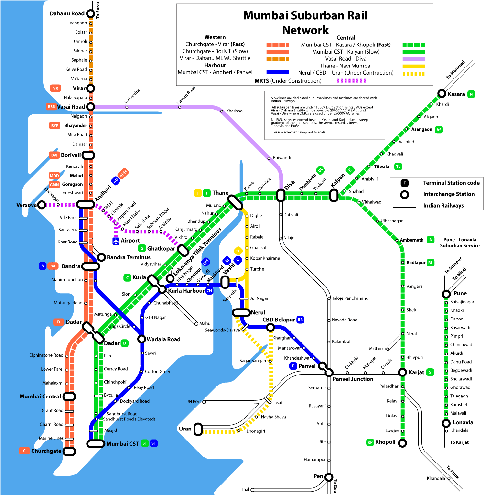
This is what the network looks like. It’s not the prettiest, I agree, but very robust and effective.


All train services run on 4 major networks or as they are called, lines.
They are as follows:
1. Western Line — Starts at Churchgate, runs parallel to the west coast and runs up to Dahanu Road which is about 120 km away. 
The Western Line is operated by the Western Railways and has the best stations, the highest frequency of trains and the newest of trains available. It carries about 3.5 million people everyday, almost half the total number.

2. Central Line — Starts at Chhatrapati Shivaji Terminus (CST), formerly known as Victoria Terminus (VT) and runs up to Kalyan about 54 km and from there it breaks into two corridors. The first goes North towards Kasara about 67 km from Kalyan. The other goes South towards Khopoli near Pune about 61 km from Kalyan. 
The Central Line is operated by the Central Railways and is somewhat inferior to the western line in terms of capacity, cleanliness, types of trains available and frequency of trains. A lot of old DC powered trains also run on this making it less efficient. The number of people who travel everyday are about 3 million. Since the number of trains is also lower, these trains are extremely crowded. In fact, all trains are! This is something I might say repeatedly in this blog since it is an essential aspect and I find it very interesting. 😀

3. Harbour Line — Starts at CST and has two major corridors. One goes till Andheri and joins the Western Line while the other runs independently and runs up to Panvel about 50 km from CST. 
This line is operated by the Central Railway and is by far the most inefficient corridor since it relies solely on old 9-car DC powered coaches and has only Slow Trains (Refer to types of trains) running on it. This line carries about 1 million commuters a day.

4. Trans-Harbour Line — This line runs from Thane to Navi Mumbai (Vashi/Nerul). It is the newest addition to the local train network and has a length of about 20 km.


Basic Fundae.

Types of Trains: 
1. Fast : These trains halt only at major stations skipping others. These are frequent only during peak hours and usually ply on longer routes.
2. Semi-Fast : These trains halt at major stations for half the journey after which they halt at all stations. These are common on routes where train frequency is less.
3. Slow : As the name suggests, they halt at all stations and constitute a major part of total services.

The best way to check all information pertaining to local trains as well as local transport in Mumbai is an app call mIndicator. It is a highly reliable application that gives you information regarding schedules, fares and routes.

Peak Timings : The timings before and after office-hours is usually when these trains are crowded. 
Morning: 6 am to 9.30 am
Evening: 5 pm to 8.30 pm

If you’re a newbie, I’d advise you to avoid travelling during these times especially via fast trains as they are packed to the limit. If you have luggage, don’t even try.

All local trains are crowded most of the time. During peak hours the trains are about 4 minutes apart and are extremely packed. For a 9-car rake, with a carrying capacity of 1700, almost 4500 people are packed into it during these times.! Also, about 12–15 standing passengers are accommodated per square meter, which sounds as insane as it is.

Types of Compartments:
1. First Class: Prettier seats is probably what you pay for since this part of the train is also crowded about the same as a normal coach. Costs about 10 times the normal fare. Use only if you travel regularly or you’re in city for a one-off visit and want to travel safe.
2. Second Class: Aam Aadmi ki savari. The well-known and (in)famously crowded coaches. People often joke about getting a few whacks and getting squeezed which is often the case. If you’re short, like me, be prepared to get additional elbow jabs as well! Quick sidenote: Take off your glasses if you can. I’ve broken two pairs already. So that’s 6k I’ll never see again. 
3. Ladies’ Compartment: Reserved for women. Three coaches placed at equal intervals along the train are specially kept for women and are usually easy to travel in. (Not that I’ve traveled in them!)
4. Ladies’ First Class: Self-explanatory.
5. Luggage Compartment: Use when you have a lot of luggage or simply when there’s no more space in the general compartment.
6. Senior Citizens’ Compartment: Reserved for senior citizens who travel and can thus avoid the rush.
7. There’s also a compartment reserved for the differently abled and cancer patients making travel easier.

Switching Lines:
You might need to switch lines if you are travelling from one part of the city to another. So there are a few stations where this is possible and can be seen on the map.
Central-Western : Dadar
Central-Harbour: Kurla
Western-Harbor: Wadala Road
Central-Western via Metro : Ghatkopar and Andheri

Another option for people who are travelling from Central to Western is to get off at Ghatkopar and use the metro to reach Andheri and then use the Western Railway. This saves a lot of time since you can see that if you want to go to say Andheri going via Dadar was the only option before Metro service started. This involves going ahead and then coming back instead of a direct route and is because of the presence of the Sanjay Gandhi National Park.


Travel Tips/Hacks

All reserved compartments have been incorporated for a reason and should be made use of whenever possible to ensure safe travel.

For Women: As far as possible try and use the Ladies’ compartment. I’m not being sexist/misogynist or anything of the sort here. I often travel with my mom,aunts and cousin sisters and frankly it’s the safest option. This eliminates to a great extent the hooliganism women have to encounter on trains. (I’ve seen it.)

Unwritten Rules:
There are some unwritten rules or etiquette that you need to follow while travelling in a local train. You’ll have a pleasant experience if you try and follow them 
1. If you want to get in or get out, just stand near the door. The force will do the rest. 
2. Wear your backpacks forward. This makes movement easier and helps take care of your luggage. 
3. Make space for a fourth person on the train seat. Even though this is meant to seat three people, it is used for four on a normal basis. But, this rule doesn’t apply to first class.
4. Don’t get into a Virar train if you want to get down at a station before Borivali. This is happened to a few friends of mine who weren’t allowed to get down on Andheri in spite of being a few feet away from the door!
5. During the peak hours if you’re sitting it implies you must’ve boarded the train at CST which is a valid assumption in most cases. So the norm is that all people sitting must offer their seats to people who are standing, after Thane, which is basically half the journey usually.
6. For the ladies’ compartment, if you need a seat you ask practically everyone who is sitting where they are getting down. If you find a match and the seat hasn’t already been taken by another person then you’re next in line for the seat. There are no such rules in the general compartment. 😛
7. While boarding a train it is necessary that you first let the people get down before attempting to get in. However, like chemistry this rule has an exception. At CST while alighting a train you need to first let the people board the train before you attempt to get down. Non-compliance may lead to receiving a few blows and in some cases continuous hits!
8. While getting down, stand up and move towards the door at least one stop before your station. Else, you might face difficulties in alighting.

Now for the fun part.

Since the trains are always so crowded and after coming from work you feel like you deserve a seat. So here’s some tips on how to get a seat or a comfortable standing place. 😛

1. When the train arrives, choose a door. While the train is slowing down grab the door and run along with it till the train stops and people get off. Dash in and hope that you get a seat!

2. If you desperately want a seat and are willing to spend some extra time because you’re too tired or you’re journey back home takes a lot of time then this is for you. Travel in the opposite direction of where you intend to go since that will be relatively easier. (Rush hour traffic is unidirectional! i.e. Down Line). Once you’ve done that the same train will reach CST/Churchgate and take you back home! Since there can be multiple destinations for a particular train you might have to try this out a few times before you get the right train!

3. The safest standing position is along the doorway. If unable to find a seat in spite of getting in early, this is the place to be!


I have a small story that someone once told me when I was attending a course on stock markets. So the speaker was explaining to us the concept of risk vs return and he used the local trains to explain this.

Here’s how the analogy goes:

While boarding a local train at CST there are four types of people.
1. The early bird — this is the person who boards a running train in hopes of getting a window seat. So, high risk high return.
2. The safe player — this person wants a seat but will settle for a second or third seat and hence goes inside a bit later when the train slows down. So, low risk low reward.
3. The no-risk taker — this person is happy getting a fourth seat or even standing and thus boards only when the train completely comes to a halt. No risk or low risk and hence low returns.
4. The gambler — this person is the ultimate gambler and wants to stand at the door. He will only board the train once it starts moving. So high risk high return.! 😀


Note: Images used are not mine.